You keep building relationships. Outsource your debit report review to PDEX.
Every month your processor sends debit reports. PDEX reviews them for you and explains, in plain English, what changed, why it changed, and what to ask next.
One number can hide two stories
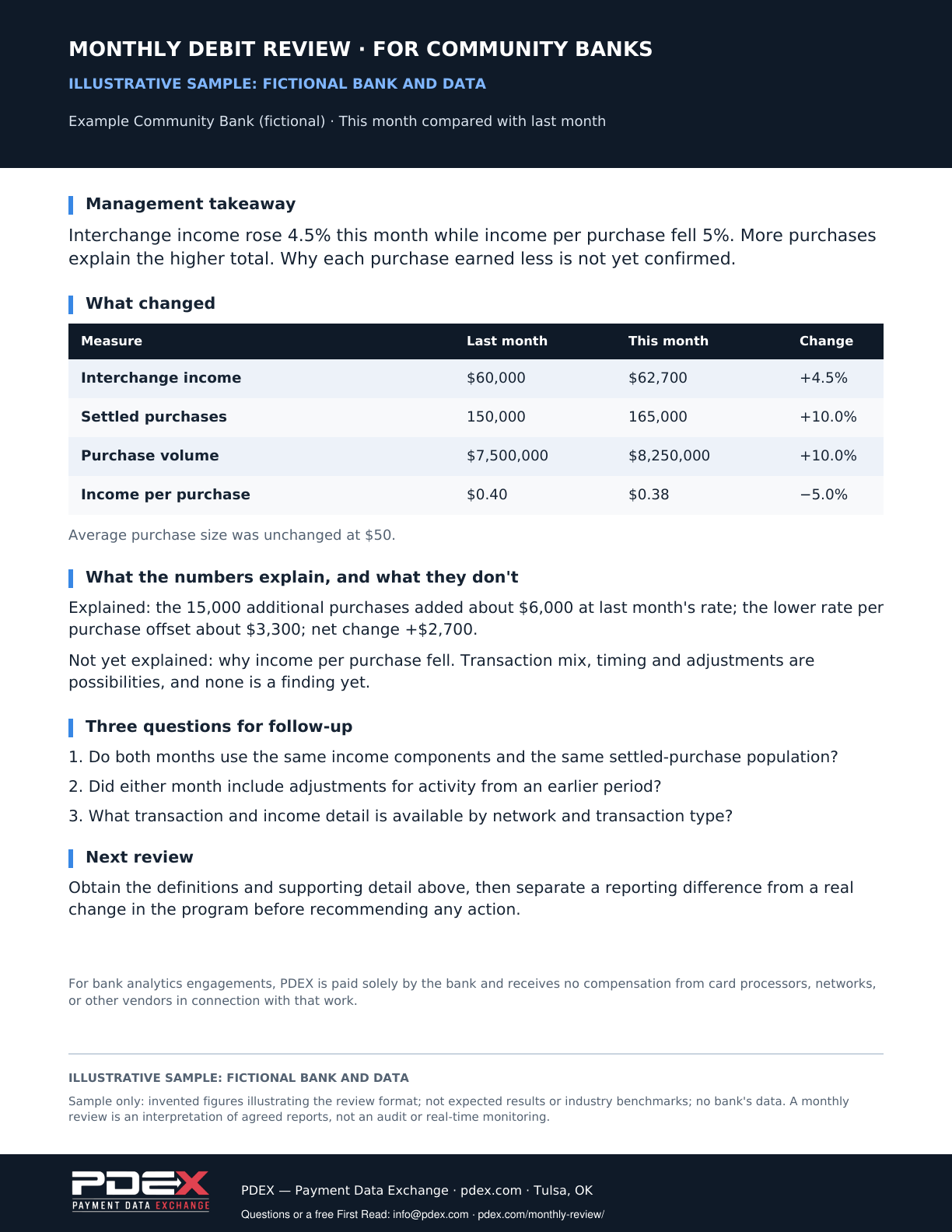
Here's the kind of thing a monthly review catches, using a fictional bank:
Debit income rose $2,700 this month. Good news?
Partly. 15,000 more purchases added about $6,000. But each purchase earned 2 cents less, which took back about $3,300.
The total looks fine. The trend underneath it needs a question: why did each purchase earn less?
Next step: ask the processor whether the mix of transactions, the timing or an adjustment explains the drop, before anyone treats it as a problem.
Example from a fictional bank. Figures are illustrative, not results or benchmarks.
Why banks hand this off
Time back for your team
The reports get reviewed every month without pulling anyone off their work.
See what the totals hide
Changes in usage, approvals and what each transaction earns, spelled out instead of buried in pages of numbers.
Ready for the board
A one-page Board Page each quarter that anyone in the room can follow.
What you get each month
- A one-page summary in plain English.
- The numbers behind every finding, so anyone can check them.
- The questions to take back to your processor.
- Follow-up on anything still open from last month.
- Each quarter, a Board Page for your board meeting.
If the reports can't answer something, we'll say so and tell you what's needed. We won't guess.
How it starts
A short walkthrough
15 minutes on the sample, or 20 minutes on your reports. No data needed.
You send the reports
Through your bank's secure email.
A free First Read
PDEX prepares it from your reports, and you decide whether a monthly review is worth it.
If you go ahead, we agree the scope, timing and fee together.
Who does the review
Reviews are prepared by Brian McDaniel, PDEX's founder, who has spent more than twenty years in payments.
For bank analytics engagements, PDEX is paid solely by the bank and receives no compensation from card processors, networks, or other vendors in connection with that work.
What it isn't
A monthly review explains agreed reports after they arrive. It isn't an audit, real-time fraud monitoring, contract negotiation or compliance certification.
See the sample first. If it looks useful, let's talk.