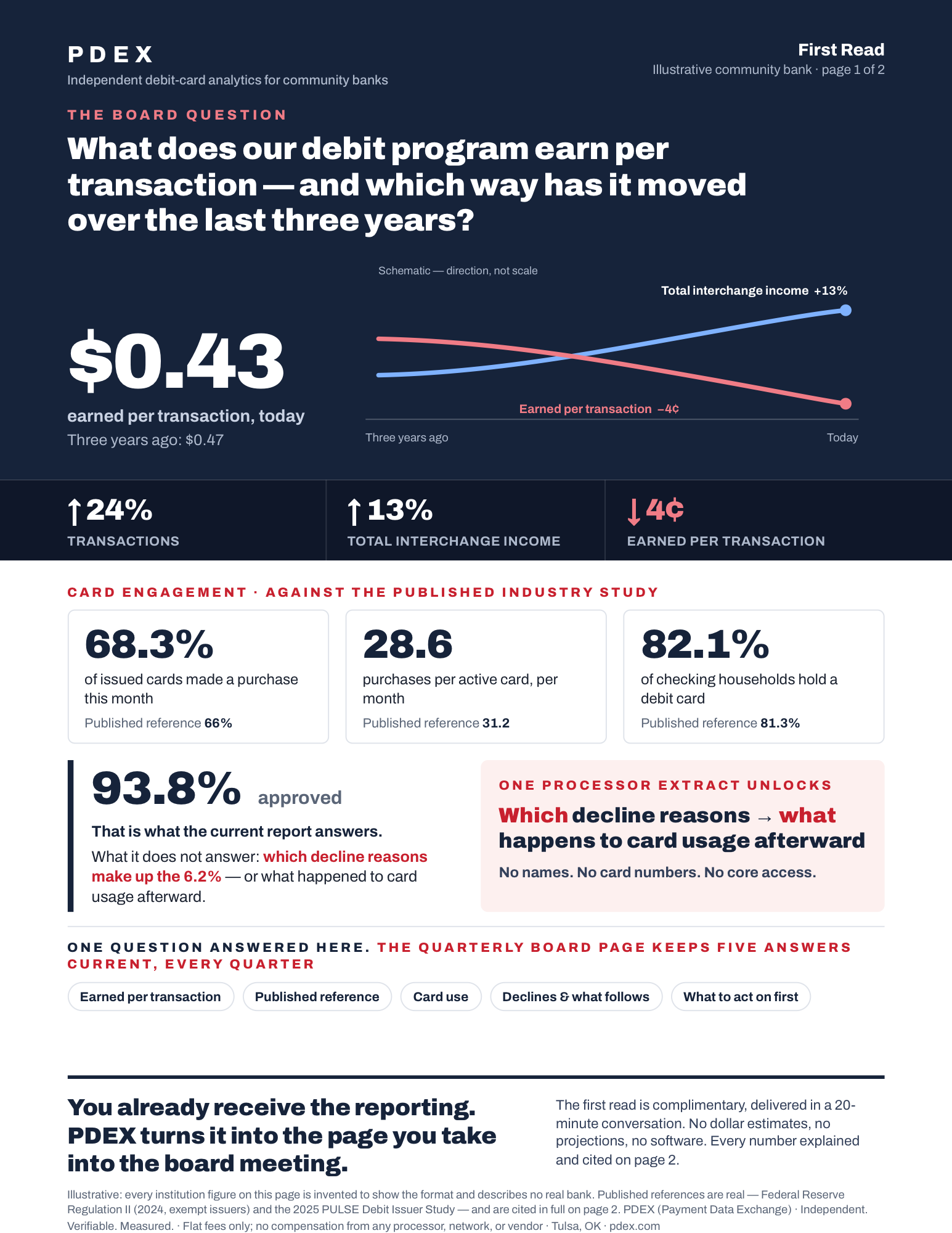
Your processor reports what happened. It does not tell you whether it was good. PDEX measures your debit program against published Federal Reserve and industry data, states each benchmark's definition alongside the metric, and gives you the questions to put to your processor.
See the problems PDEX solves, review a sample benchmark report, and understand what's driving the revenue gap in most community bank card programs.
Four steps. No software to install. No integration required. We work with the standard reports your processor already generates.
How an engagement works — from the initial complimentary read to the annual benchmark subscription.
PDEX provides payment processing to businesses across industries. Deep interchange expertise on both sides of the transaction.
We're currently working with a select group of institutions. Submit a request and we'll follow up within two business days. No commitment. No software to install.
Your processor tells you what happened. PDEX tells you how those numbers compare to published Federal Reserve and industry data, and which of them warrant a closer look. No software. No PII. No guesswork.
Your processor shows you your own numbers in isolation, measured against its own book. PDEX measures them against published Federal Reserve and industry data — and names the definition behind every benchmark it uses.
Dual-message and single-message rails carry very different yields — the Federal Reserve reported 1.41% and 0.67% respectively for exempt issuers in 2024. Your transaction mix decides where volume lands, and most banks have never had that mix measured against published data.
Every processor reports tokenized volume differently, and most programs have never had the figure normalized or set against a published study. What it means for yield depends on the networks you have enabled and how merchants route — not on how the cardholder taps.
Overly tight fraud settings are declining legitimate transactions. That has a measurable dollar cost most programs never quantify.
Without a reference outside your own processor, you can't know whether a metric is a problem or simply a feature of your mix. PDEX measures every metric against published Federal Reserve and industry data.
| What PDEX Measures | Published Benchmark | Source |
|---|---|---|
| Blended interchange yield | Exempt-issuer averages: 1.41% dual-message · 0.67% single-message | Fed Reg II, 2024 |
| Mastercard signature rate | 1.30% exempt-issuer average | Fed Reg II, 2024 |
| PIN network rate | 0.51% – 0.75% by network | Fed Reg II, 2024 |
| Cards enrolled in digital wallets | 38% of debit cards (2023, latest published) | PULSE Study |
| Transactions per active account / mo | 31.2 POS per active card (all issuer sizes) | PULSE Study, 2024 data |
| Monthly spend per active account | ≈ $1,500 (all issuer sizes) | PULSE Study, 2024 data |
| Active rate | 66.0% of all issued cards · “good performance” band 60–68% | PULSE Study, 2024 data |
| Business debit, per transaction | $1.64, exempt issuers | PULSE Debit Issuer Study, 20th ed. |
Where does your program sit against each of these? That’s the measurement.
Every figure above is published and its source is named. A network rate is measured only against a network benchmark, and a transaction-category average only against the same category — they are different cuts of the data and are never set against each other. Your own figures are placed beside these in your engagement.
No client program data. PDEX does not publish any institution’s figures, anonymized or otherwise. No projected revenue, and no routing outcome inferred from how a cardholder pays — a transaction’s path depends on the networks the bank has enabled and the merchant’s routing configuration, not on the gesture.
PDEX never receives customer names, account numbers, or transaction-level detail. You share only aggregated program performance reports — the same summary data your team already reviews internally. No PII is ever transferred, stored, or required. This removes the compliance objection before the first conversation.
The difference between knowing your numbers and understanding them is experience. PDEX was built by someone who has processed real transactions and lived inside interchange economics.
20+ years of interchange economics, network routing strategy, and card program operations. Consulting firms benchmark from the client books they've worked; PDEX's view is built cross-processor — Jack Henry, Fiserv, FIS, and CSI.
PDEX works exclusively with aggregated performance data. This removes the compliance team's primary objection before the first conversation. No integration risk. No data governance issue.
Your processor can only measure you against its own book. PDEX measures your program against published Federal Reserve and industry data — a reference no processor can supply. PDEX peer-group benchmarks are added as the contributing network grows.
Every identified gap comes with a prioritized playbook — specific tactics, estimated revenue impact, and clear next steps your team can act on immediately. Not a deck. A plan.
PDEX is not owned by a processor, a network, or a bank. That independence means our analysis is objective. We work with Jack Henry, FIS, Fiserv, or any other processor's standard reports.
You export the reports your team already reviews. We do the analysis. No IT project. No onboarding timeline. No implementation risk. Results within days of engagement.
We work exclusively with the standard reports your processor already generates. No integration. No IT project. No new software. You export, we analyze, you get a ranked playbook — typically within a week of your first report submission.
Export your standard debit program reports from your processor's reporting portal and send them to PDEX. These are the same summary reports your team already reviews internally — no customer data, no PII, no transaction-level detail is ever needed or requested.
We clean and normalize your data, then measure each metric against the relevant published Federal Reserve or industry figure — with that figure's definition stated alongside it, because definitions and issuer mix vary between studies. PDEX peer-group benchmarks are added as the contributing network grows.
Every metric that sits below its published benchmark is quantified against your own program volume, so your team can prioritize what to look at first. Quantified findings are released under a signed engagement.
Each identified gap comes with a prioritized action playbook — specific tactics drawn from published network and industry practice, with estimated revenue impact and clear next steps. Your team decides what to act on. We don't manage your card program. We give you the intelligence to run it better.
PDEX never receives customer names, account numbers, or transaction-level detail. You share only the aggregated performance reports your team already reviews — the same data your processor provides in their standard reporting portal. No IT project. No compliance review. No data governance issue.
Flat annual subscription based on asset size. No setup fees. No per-report charges. No contracts beyond the annual term. Every tier includes the full suite of program measurement, yield analysis, and action playbooks.
You export the standard reports your processor already produces. We return a directional read across the four pillars — where the program looks strong and where it warrants a closer look. No dollar figures, no cost, no commitment.
A signed engagement unlocks the quantified findings: every metric below its published benchmark is quantified against your own volume, prioritized into an action playbook your team can execute.
Ongoing measurement against published data, quarterly playbook updates, and year-over-year trend tracking. The tiers below reflect asset size.
A flat annual fee set by asset size. One invoice per year. No setup fees. No per-report charges. No contracts beyond the annual term.
Your subscription starts from day one — no onboarding or implementation charges. We begin analysis as soon as you send your first program reports.
We work with standard reports your processor already generates. No integration, no API access, no IT project. Export and send — that's it.
Jack Henry, FIS, Fiserv, or any other core processor. We normalize whatever format your reports come in — no vendor coordination required.
One invoice per year. Simple budgeting with no monthly surprises. No per-report charges. No usage fees. Flat rate based on asset size.
PDEX operates as a registered ISO, providing reliable payment processing to businesses across industries. Our interchange expertise means every merchant relationship is built on operator-level knowledge.
PDEX operates as a registered Independent Sales Organization (ISO), providing reliable payment processing to businesses across industries. Our ISO background and deep interchange expertise mean merchant clients benefit from the same operator-level knowledge that drives our bank intelligence platform.
We understand what it costs to accept a transaction — not from a spreadsheet, but from 20+ years of processing real volume across networks, merchant categories, and card types.
Registered ISO with 20+ years of experience. We understand interchange economics from the ground up — not from a spreadsheet. That depth benefits every merchant relationship we manage.
Full card acceptance across Visa, Mastercard, Discover, and Amex networks.
Modern POS hardware and software for retail, restaurant, and service businesses.
Secure online payment gateways for your existing platform or custom storefront.
Accept payments anywhere with mobile card readers and contactless technology.
Electronic check and ACH processing for recurring billing and B2B payments.
Interchange-informed rate review to ensure you're not overpaying on processing fees.
PDEX measures debit card programs at chartered community banks and credit unions. The measurement is built from the standard reports your processor already produces, and compared against published Federal Reserve and industry data. The initial read is complimentary — no cost, no commitment, and no software to install.
Every request is read personally and answered within two business days. No commitment required. No software to install. PDEX never receives customer names, account numbers, or any other PII — at any stage.
For questions about the PDEX platform, benchmark methodology, or engagement model:
info@pdex.com
For merchant services inquiries — payment processing, POS, or rate analysis:
info@pdex.com
We review each request personally and take on a limited number of institutions at a time. Every engagement receives principal-level attention from day one.
* Required. Submissions go directly to info@pdex.com.
No software to install. Reply within two business days.